

Preparing for pharmacy entrance and semester examinations requires proper planning, regular practice, and a clear understanding of important subjects. Whether students are planning to enter a pharmacy programme after Class 12 or preparing for their college examinations, an organised study routine can make the learning process more effective.
Pharmacy education includes various scientific and technical subjects that require both theoretical understanding and practical knowledge. Students need to develop good study habits, revise important concepts, and practise regularly to perform well in their examinations.

Understand the Examination Pattern and Syllabus
Before starting preparation, students should understand the examination pattern and syllabus. Different pharmacy entrance examinations may have different eligibility requirements, subjects, marking schemes, and question formats.
For students preparing for pharmacy entrance examinations, important subjects generally include:
Physics: Basic principles, measurements, numerical problems, and fundamental concepts.
Chemistry: Organic chemistry, inorganic chemistry, chemical reactions, and calculations.
Biology: Human physiology, cell structure, genetics, and biological processes.
Mathematics: Important formulas, calculations, and problem-solving concepts, wherever applicable.
Students should refer to the latest official syllabus and examination guidelines to ensure that their preparation covers the required topics.
Create a Practical Study Timetable
A study timetable helps students divide their syllabus into manageable sections. Instead of studying everything at once, they should assign specific time slots to different subjects according to their difficulty and importance.
For example, students can dedicate morning hours to understanding new concepts, afternoon sessions to solving numerical questions, and evening time to revision. Difficult subjects may require additional attention, while familiar topics can be revised through shorter sessions.
Students should also include regular breaks and weekly revision periods in their schedules. A realistic timetable that can be followed consistently is more useful than an overly demanding plan.
Focus on Understanding Important Pharmacy Subjects
Once students begin their pharmacy education, they encounter specialised subjects that form the foundation of their academic learning. Understanding these subjects is essential for performing well in semester examinations.
Some important areas include:
Pharmaceutics: Introduces students to different pharmaceutical formulations, dosage forms, and the principles involved in preparing pharmaceutical products.
Pharmaceutical Chemistry: Helps students understand chemical structures, properties, reactions, and the composition of different substances.
Pharmacology: Covers how different substances interact with the human body and explains their effects and mechanisms.
Pharmaceutical Analysis: Focuses on analytical methods used to identify substances and evaluate their quality and composition.
Pharmacognosy: Introduces naturally derived materials and their applications in pharmaceutical science.
Students should focus on understanding basic concepts before moving towards complex topics. This approach makes it easier to answer descriptive questions and apply theoretical knowledge.
Practise Previous Question Papers and Mock Tests
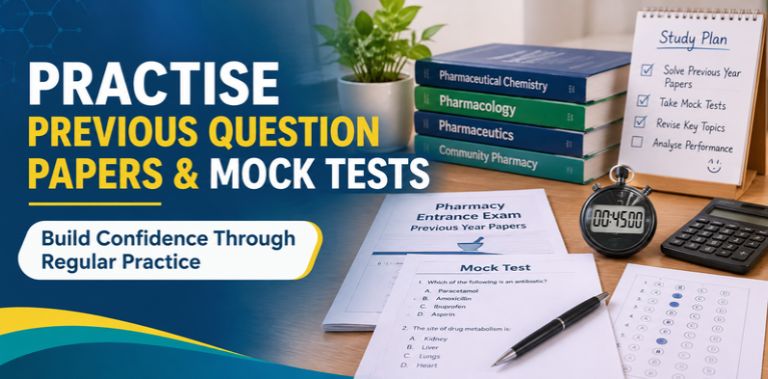
Solving previous question papers is a useful way to understand examination patterns and identify areas that need improvement. It also helps students become familiar with different question formats.
Mock tests are equally important because they allow students to practise within a fixed time limit. After completing a test, students should review incorrect answers and revisit the topics they found difficult.
For semester examinations, previous university question papers can provide an idea of frequently discussed topics. However, students should not depend entirely on repeated questions. Studying the complete syllabus is important for developing a strong understanding of each subject.
Prepare Short Notes for Quick Revision
Making short notes is an effective study technique, particularly when the syllabus contains multiple subjects and detailed topics. Instead of reading entire chapters repeatedly, students can use organised notes to revise important information.
These notes may include:
Important definitions and terminology.
Scientific concepts and key principles.
Important formulas and calculations.
Diagrams and flowcharts.
Differences between related topics.
Short explanations of complex processes.
Students should prepare notes during regular study sessions and update them whenever they learn something new. This makes revision more organised before examinations.
Give Importance to Practical Learning
Pharmacy education involves both classroom teaching and practical sessions. Laboratory activities help students understand how theoretical concepts are applied in different areas of pharmaceutical science.
Students should participate actively in practical classes, understand laboratory procedures, and maintain their practical records regularly. They should also learn the purpose of different instruments and techniques instead of simply memorising experimental steps.
Practical preparation is important because semester assessments may include laboratory examinations, viva questions, and practical record evaluation.
Manage Time and Examination Stress
Good preparation also depends on maintaining a healthy routine. Students should avoid leaving the entire syllabus for the final days and instead revise topics consistently throughout the semester.
Getting adequate sleep, taking short breaks, and maintaining a balanced daily schedule can help improve concentration. Students should also seek guidance from teachers whenever they find a topic difficult to understand.
Breaking large study targets into smaller tasks can make preparation less stressful and help students track their progress.

Pharmacy Education at Orlean College of Pharmacy, Greater Noida
Choosing the right educational institution is an important step towards building a career in pharmacy. A supportive academic environment helps students understand scientific concepts, gain practical exposure, and develop the knowledge required for their future professional journey.
Orlean College of Pharmacy, Greater Noida, offers D.Pharm and B.Pharm programmes for students interested in pharmaceutical education. Through academic learning and practical exposure, students can explore important pharmacy subjects and develop a foundation for opportunities in the pharmaceutical and healthcare sectors.
Make Your Examination Preparation More Effective
Preparing for pharmacy entrance and semester examinations becomes easier when students follow a structured study routine, practise regularly, and focus on understanding important concepts. Revision, mock tests, practical learning, and effective time management all contribute to better academic preparation.
With consistent effort and proper academic guidance, students can strengthen their knowledge, improve their confidence, and prepare themselves for the next stage of their pharmacy education.